The Overnight Software Factory


How AI-Native Teams Will Build Products Every 24 Hours
For decades, software development has followed a familiar rhythm.
Teams gather requirements.
Developers write code.
QA tests it.
Two weeks later, a new release goes out.
That rhythm is about to break.
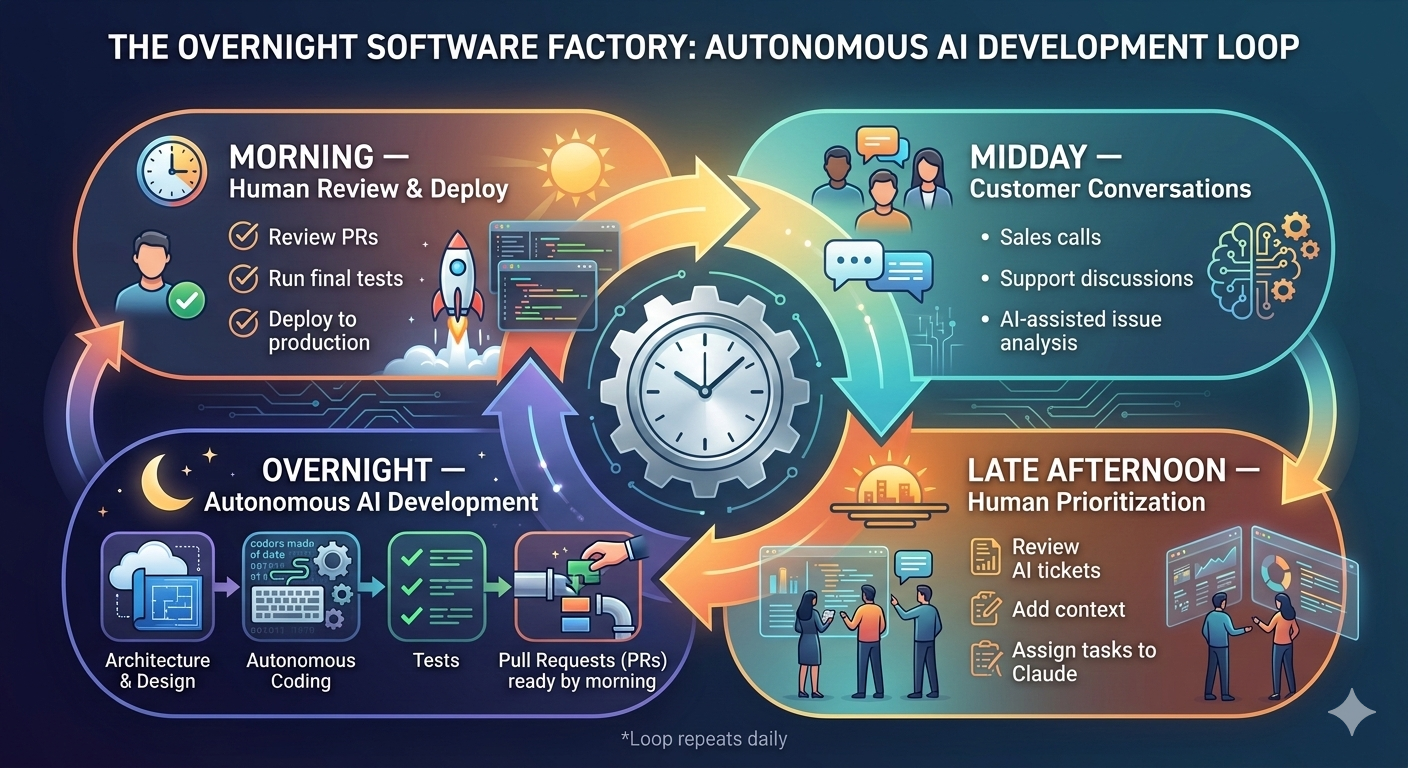
With tools like Claude Code moving toward autonomous auto-mode, we are beginning to see a new operating model emerge — one where humans and AI collaborate in a continuous 24-hour cycle.
Welcome to the daily sprint.
Humans think during the day.
AI builds during the night.
The result is something I call the Overnight Software Factory.
The Old Model: Humans Do Everything
Traditional software teams are built around human labor.
Developers:
- write code
- fix bugs
- run tests
- manage deployments
- update documentation
Product managers write tickets.
Engineers implement them.
QA verifies the work.
Even in fast teams, this process takes days or weeks. Hence the typical 2-week sprint.
The New Model: Humans Design, AI Builds
AI changes the equation.
Modern coding agents can already:
- design solutions
- write code
- refactor systems
- generate tests
- open pull requests
When these agents can run autonomously for long periods, a new workflow becomes possible.
Instead of humans doing the implementation, they focus on:
- understanding customer problems
- defining what should be built
- reviewing the results
The AI handles the rest.
The 24-Hour AI Development Loop
The future development cycle may look like this.

Morning: Review and Deploy
The team begins the day by reviewing the work the AI completed overnight.
Pull requests are ready.
Tests have already run.
Documentation is generated.
The team:
- reviews PRs
- runs final end-to-end testing
- approves changes
- deploys to production
By noon, the product is updated.
Every day becomes a release day.
Midday: Talk to Customers
This is where humans create the real value.
Instead of sitting in front of an IDE all day, the team focuses on learning from users.
Activities include:
- customer calls
- sales conversations
- support discussions
- product feedback
- domain research
These conversations are recorded and analyzed.
AI systems listen to every call and automatically extract:
- feature requests
- bugs
- workflow improvements
- integration needs
Instead of manually writing tickets, the AI generates them automatically.
Automatic Ticket Creation
From a single conversation, the system might generate something like this:
Repo: inspection-platformTicket:
Allow inspectors to attach video to inspection reportsContext:
Customer: ABC Energy
Inspectors currently record video separately
and upload it later.Impact:
Adds 20 minutes per job.Acceptance Criteria:
- support video attachments
- max file size 200MB
- optimized mobile uploadEach product repository effectively has its own AI development team.
Late Afternoon: Human Prioritization
Toward the end of the day, the human team reviews all tickets generated during the day.
This step is critical.
The team:
- prioritizes tickets
- merges duplicates
- adds additional context
- clarifies specifications
- assigns work to Claude
The better the instructions, the better the results.
This becomes the new core engineering skill:
writing clear, actionable specifications for AI.
Night: Autonomous Development
When the team signs off for the day, the AI begins working.
Agents run through the entire development pipeline:
- design architecture
- implement features
- refactor existing code
- write unit tests
- run test suites
- generate documentation
- open pull requests
All night, the system builds.
The human team sleeps.
The agents code.
Morning: A New Version Is Ready
By the next morning, the repositories contain:
- completed pull requests
- test results
- architectural notes
- deployment instructions
The team reviews the work.
Approve → merge → deploy.
By noon, the improvements are live.
And the cycle begins again.
Why This Model Works
Humans and AI are good at different things.
Humans are best at
- understanding messy real-world problems
- talking to customers
- prioritizing work
- defining product direction
AI is best at
- writing code
- refactoring systems
- generating tests
- executing repetitive engineering tasks
This division of labor dramatically increases productivity.
Instead of spending most of their time coding, humans focus on learning what should exist.
The Rise of the Tiny Product Team
Under this model, a startup team might look like this:
- Product Architect
- Domain Expert
- AI Systems Engineer
- Infrastructure Engineer
That’s it.
Four people.
Yet they can ship software every single day.
This is exactly the kind of structure that enables Freedom Startups — companies designed to run lean and efficient by automating repetitive work so founders can focus on value creation.
When Development Becomes Cheap
When AI can implement software quickly and cheaply, the biggest constraint shifts.
It’s no longer engineering capacity.
The real bottleneck becomes:
finding the right problems to solve.
The most successful founders will not be the best coders.
They will be the best problem observers.
They will find the operational frustrations that managers deal with every day — inefficient workflows, repetitive processes, manual reporting — and build solutions that remove those pains.
Because solving these mundane but persistent problems is where sustainable businesses are built.
Solving Mundane Business Proble…
The Future of Building Software
For decades we optimized how humans write code.
Now we must optimize how humans direct AI to build software.
The best teams will not be the ones with the most developers.
They will be the ones who:
- learn from customers fastest
- define problems most clearly
- direct AI most effectively
In that world, software development becomes a continuous loop.
Humans discover problems.
AI builds solutions.
And every morning, a new version of the product is ready.
Welcome to the Overnight Software Factory.
Ready to build in the AI-first era?
If you’re exploring how to turn real operational problems into AI-driven products, consider joining our incubation program.
👉
https://incubation.zenithstudio.io
We’re helping founders build the next generation of freedom startups.